
THE SHORT ANSWER
An internal report and an external discrimination process can run on separate calendars. Identify your employment system and ask the appropriate office about timing without waiting for HR to finish.
What to keep in mind
- An internal grievance generally does not extend the EEOC charge period.
- The general charge framework is 180 days, sometimes 300; federal counselor contact generally uses 45 days.
- Track events and notices separately instead of relying on a single complaint date.
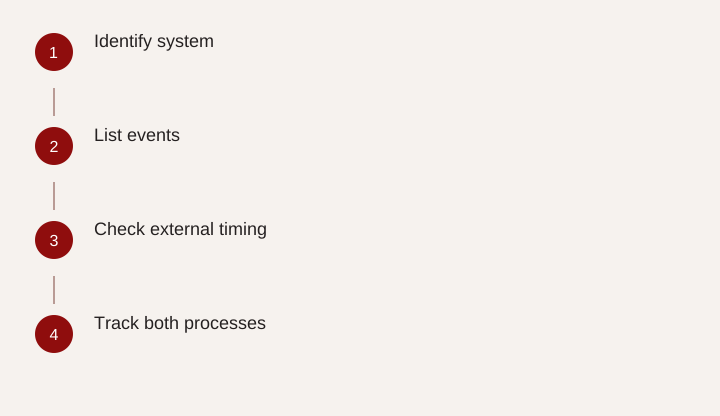
- Identify system
- List events
- Check external timing
- Track both processes
Treat internal and external processes as separate calendars
Reporting discrimination to HR can be an important step, but it does not automatically preserve every external right. The employer may be interviewing witnesses, considering a resolution or waiting for a manager to return. Those activities do not necessarily change the deadline for contacting or filing with the appropriate outside process.
The EEOC's filing-deadline guidance says that internal grievances, union grievances, arbitration and mediation generally do not extend the charge-filing period. This is why “HR is still investigating” should not be your only timing plan.
You do not have to abandon an internal effort to obtain information about external timing. The immediate task is to identify the correct process and ask a timely question. Waiting until you have a complete evidence file or a final internal decision can create an avoidable problem.
Identify your employment system first
For many private-sector and state or local government discrimination matters, the EEOC describes a general 180-calendar-day charge period, which may extend to 300 days when a qualifying state or local enforcement law applies. Age-discrimination extension rules differ. Other claims and routes can also have different requirements, so the number should not be selected from a generic internet checklist.
Federal employees and applicants generally begin by contacting an agency EEO counselor within 45 days. The federal EEO overview explains that separate procedure. A county employee is not a federal employee simply because the employer is governmental.
Before discussing dates, write down the actual employer and whether you are an employee or applicant. If contractor status or another arrangement makes the route uncertain, explain that uncertainty to the relevant office rather than choosing the longest deadline you find.
Identify the events that may start different questions
A complaint can contain more than one employment event. A denied promotion, later demotion and subsequent discharge do not necessarily share one timing analysis. Nor should a recurring pattern of alleged harassment be treated exactly like a series of discrete personnel decisions.
The EEOC deadline page explains that timing can apply to individual events and discusses harassment differently. That is a reason to make a chronology, not to calculate a legal conclusion yourself. Record decision dates, notification dates, effective dates and later incidents as separate fields where they differ.
For a hypothetical example, an employee reports a denied promotion to HR and is later reassigned. The internal report date does not automatically answer whether either event is timely for an external charge. A qualified reviewer needs the relevant dates and the nature of each action. An older event may remain background without becoming a timely standalone claim.
Use a two-track process sheet
Keep the internal process and external timing inquiry visible side by side. The table should record questions and confirmed instructions, not an assumed deadline generated from a single number.
| Item | Internal track | External timing track |
|---|---|---|
| Relevant event | What HR is reviewing. | Each decision or pattern to discuss with the appropriate office. |
| Contact | Assigned HR or investigator contact. | EEOC field office, agency EEO office or qualified adviser as applicable. |
| Dates | Report, acknowledgment and promised update. | Event, notice, effective date and confirmed submission instructions. |
| Next step | Information requested or follow-up meeting. | Action needed to clarify or preserve the applicable process. |
| Evidence of action | Receipt or written confirmation. | Confirmation of the actual procedural step completed. |
An appointment request or a saved draft may not equal a filed charge. Ask what action has actually been completed and keep its confirmation.
Ask a useful timing question
When contacting the appropriate office, give enough information to identify the issue: employer type, relevant events, dates and any process already started. Do not ask only, “How long do I have?” without explaining which action concerns you.
A useful inquiry is: “I reported [event] internally on [date]. HR's investigation remains open. The decision occurred or was communicated on [date], and it took effect on [date]. I work for [employer type]. Which process applies, and what must I do now to address the filing or contact requirement?”
If you have received a notice, read it carefully and provide its date and wording. Do not assume a prior internet answer overrides a current procedural instruction. If the answer is unclear, ask for clarification promptly and consider qualified assistance. A general article cannot evaluate extensions, exceptions or disputed notice dates for an individual case.
Avoid the common waiting traps
Do not wait for the employer to admit wrongdoing, for every witness to agree or for a new job before checking timing. Those events may never occur, and they are not a reliable basis for a deadline plan. An internal promise to make things right also deserves careful distinction from an actual agreement affecting a legal process.
Continue supplying relevant information to the internal review if you choose, while tracking any external steps separately. If new conduct occurs, ask whether it requires an additional submission. Do not assume the first complaint automatically covers everything that follows.
The practical objective is straightforward: preserve a clear record of events and obtain the correct procedural instructions early. An internal investigation may resolve the problem, but its pace should not be mistaken for the pace of every other process available to you.
Related questions
Does HR saying an investigation is ongoing stop the EEOC clock?
Generally no. EEOC guidance says internal grievances and other dispute-resolution efforts generally do not extend charge-filing limits. Ask the appropriate office promptly about your circumstances.
Do federal employees use the same 180- or 300-day starting deadline?
Federal employees and applicants generally must first contact their agency EEO counselor within 45 days. That is a separate process from the usual EEOC charge route.
Sources & further reading
Primary references
Community questions behind this guide
These discussions informed the question and language. Personal accounts are not verified facts or professional advice. Read our method.