
THE SHORT ANSWER
Preserve the selection timeline, criteria, your qualifications and any relevant statements. Separate a concern about bias from assumptions about the selected candidate.
What to keep in mind
- Identify the specific selection decision and when you learned about it.
- Keep relevant statements and criteria alongside your qualification evidence.
- Do not obtain other applicants' confidential records or assume the newest event revives older claims.
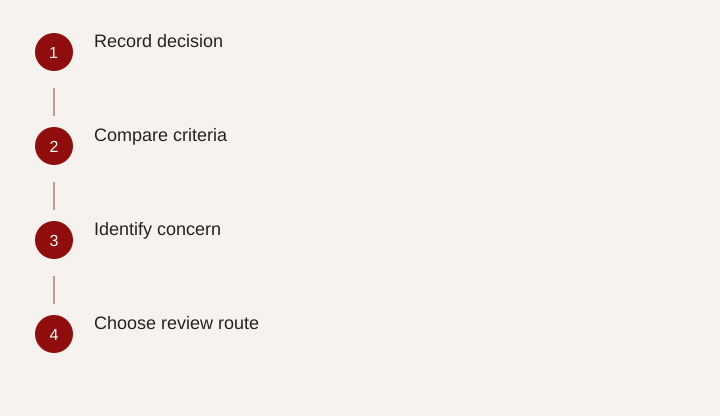
- Record decision
- Compare criteria
- Identify concern
- Choose review route
Identify the decision you want reviewed
A missed promotion can raise both a career-planning question and a discrimination concern. Keep them separate enough to examine each. Begin with the position, application or selection process, decision-maker, notification date and any effective date you know.
Write down why you suspect discrimination. Was there a statement about national origin, sex, age, disability or another relevant characteristic? Did the criteria change in a way connected to that concern? Was there a pattern you can describe with facts? Feeling more qualified than the selected person is not the same as knowing why the decision was made.
The EEOC national-origin guidance includes promotion and assignment decisions within its discussion. It can help identify relevant questions, but an article cannot decide the reason for a particular selection from a short account.
Preserve the selection record you are entitled to use
Keep or identify the job announcement, qualification criteria, application, interview instructions, feedback and relevant communications through authorized means. Record the version and date where criteria may have changed. Preserve your own evaluations and work examples that directly relate to the role.
Do not seek access to other candidates' personnel files or private interview records. You can ask the employer to review comparative selection information through the proper process without obtaining it yourself. Avoid relying on workplace rumors about the selected person's background.
A hypothetical applicant may believe a recent graduate was selected despite having more years of experience. That fact alone does not establish the full comparison. The role may weigh particular skills differently. The applicant should identify their own evidence against the announced criteria and the specific facts that raise a concern about prohibited considerations.
If the posting has been removed, note its identifier, title and the date you accessed it, and ask the appropriate office how to obtain an authorized copy. Do not recreate missing selection criteria from memory and present them as the original announcement.
Distinguish facts, gaps and interpretation
Use a decision record that allows uncertainty. A strong account does not need to pretend that you know what happened in a closed selection meeting.
| Record item | What to enter |
|---|---|
| Position and process | Posting, eligibility, interview and selection stages. |
| Your evidence | Qualifications and examples tied to the stated criteria. |
| Decision information | Who notified you, what was said and when. |
| Concerning facts | Specific statements, inconsistent criteria or relevant treatment. |
| Unknowns | Information an authorized reviewer may need to obtain. |
| Possible explanation | The employer's stated reason and any unresolved inconsistency. |
Do not convert a gap into an accusation. “I do not know whether the panel considered my project leadership” is a question. “The panel deliberately ignored it because of my ethnicity” requires a factual basis beyond the uncertainty itself.
Ask for clarification without obscuring the concern
Request the criteria and feedback on your candidacy. If you believe a particular comment or practice may reflect discrimination, say so accurately. A vague request for career advice may not communicate the concern you want reviewed.
I would like clarification of the selection for [position]. Please explain the principal criteria and the areas where my application or interview did not demonstrate the required level. I am also concerned about [specific statement or treatment] and whether it affected the decision. I am requesting that this concern be reviewed through the appropriate process. I can identify relevant records and provide a concise chronology.
Adjust the message to the actual facts. Do not insert a protected characteristic merely to strengthen a complaint. If the concern is unfair favoritism without a known discrimination connection, describe it as such and ask which policy applies. Accurate framing helps the employer route the issue.
Keep timing separate from the feedback process
The date you receive useful feedback may be later than the date of the selection decision. Do not assume that waiting for an explanation moves every external deadline. The EEOC deadline guidance explains the general charge framework and warns that internal processes generally do not extend it.
Federal applicants and employees should instead review the agency EEO process, including the general counselor-contact requirement. State or local government employment should not be confused with federal employment.
If several promotion decisions are involved, list each date separately. An older decision may provide context without being a timely standalone issue. Ask a qualified contact how the timing applies rather than choosing the most recent date and assuming it covers the entire history.
Maintain both a review file and a career plan
A discrimination review and a development conversation can proceed as distinct activities. You may seek a fair review while also asking what skills or opportunities would support your next step. Participating in one does not require you to abandon the other.
Keep work expectations clear and record any significant new treatment through the appropriate channel. Do not undermine the selected colleague or assume they participated in a biased decision. They may know little about the process that concerned you.
At the end of your preparation, the file should answer four questions: which decision is at issue, what qualifications and criteria are relevant, what facts suggest a prohibited influence and what remains unknown. That is a more useful basis for review than either certainty without evidence or dismissing your concern because you cannot see every part of the selection process.
Related questions
Does having more experience prove the promotion was discriminatory?
No. Experience may matter, but selection can involve several criteria. The question is whether prohibited considerations affected the decision, which requires a fuller factual review.
Should I wait for detailed feedback before checking a deadline?
No. You can seek feedback while promptly asking the appropriate office about timing. An internal discussion should not be assumed to preserve an external deadline.
Sources & further reading
Primary references
- EEOC Enforcement Guidance on National Origin Discrimination
- Time Limits for Filing a Charge
- Overview of Federal Sector EEO Complaint Process
Community questions behind this guide
These discussions informed the question and language. Personal accounts are not verified facts or professional advice. Read our method.