
THE SHORT ANSWER
Silence is not a usable accommodation decision. Ask who owns the request, what remains outstanding and what can address the work barrier while the review continues.
What to keep in mind
- Confirm receipt and the person responsible before repeatedly resending documents.
- Ask for specific outstanding information and a concrete next update.
- Do not invent a universal response deadline or assume delay alone proves retaliation.
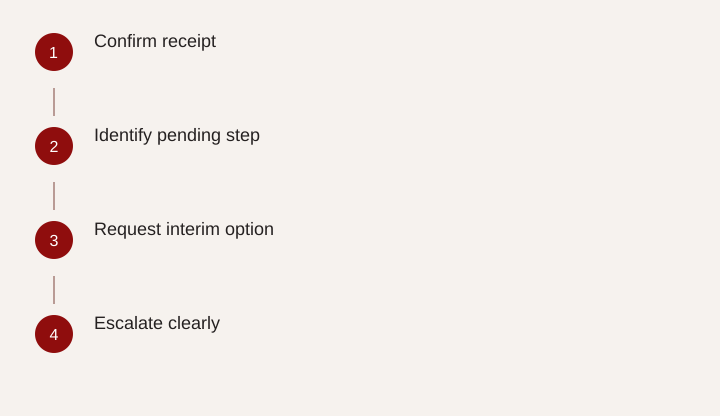
- Confirm receipt
- Identify pending step
- Request interim option
- Escalate clearly
Find out whether the request reached the right person
An unanswered request can be stalled at several points: a supervisor may not have forwarded it, a coordinator may be waiting for information, or a decision-maker may not have reviewed it. Repeatedly sending the same documents to the same address does not reveal which step is missing.
Begin by confirming receipt, the assigned contact and the status of the request. Ask whether it is considered complete enough for review and, if not, what specific information remains outstanding. Record the answer and the person responsible for the next action.
Do not treat silence as approval or denial. You need a clear instruction about the process and the current work arrangement. If the request affects an upcoming shift, required task or other immediate situation, explain that timing specifically rather than relying only on the original submission date.
Describe the present effect of the delay
A follow-up is more useful when it explains what the unresolved barrier is doing now. Are you unable to access a system, struggling with a task, using an ineffective temporary arrangement or waiting for equipment? Describe the work consequence without exaggerating it.
For a hypothetical example, an employee requested an accessible input device and has received no status update. A useful message explains which daily tasks remain difficult, whether a loaner device is available and what decision is needed to obtain it. It does not need to speculate that the employer intends harm.
The JAN follow-up guidance recommends checking on delays and clarifying what is needed. This keeps the discussion connected to the actual barrier rather than turning it into a dispute over how many unanswered emails are enough.
Ask about an interim effective option
A temporary arrangement may help while information or a final decision is pending. Suggest an option if you know one, and explain its purpose. Ask whether it can be considered rather than announcing that you will implement it yourself.
Interim options might involve temporary equipment, a different communication method or a short-term work arrangement, depending on the job and limitation. The option should address the barrier and be evaluated for effectiveness. It should not simply shift the problem to another task or require you to agree that no further accommodation is needed.
For federal telework cases, the current EEOC/OPM FAQ discusses individualized processing and cautions that centralized review should not excuse unreasonable delay. That federal guidance is not a universal deadline for every employer or a promise that a requested interim telework arrangement must be approved.
Use a staged follow-up sequence
The sequence below avoids both endless silence and a flood of increasingly long messages. Adapt the timing to the actual need, employer procedure and responses received; it is not a legal timetable.
| Stage | Purpose | Question |
|---|---|---|
| Receipt check | Confirm the request is in the right process. | Who is handling it, and was the submission received? |
| Completeness check | Identify a missing step. | What specific information or approval is outstanding? |
| Barrier update | Explain the current work impact. | Can an interim effective option be considered? |
| Status commitment | Obtain an accountable next action. | Who will act, and when will I receive an update? |
| Process escalation | Address continued lack of response. | Which designated contact can review the delay? |
When a response arrives, update the sequence instead of continuing to send the next template automatically. A request for relevant information may require your action before the review can proceed.
Send a short status message
A focused message should let the recipient answer without reconstructing the whole history. Reference the original request, identify the unresolved step and state the current need.
I submitted my accommodation request on [date] and provided [requested information] on [date]. Please confirm the assigned contact and whether anything remains outstanding. The current barrier is [specific effect on work]. While the review continues, could [temporary option] be considered? Please identify the next action, its owner and when I should expect a status update. I have included the prior reference number or message for context.
If the recipient says another office owns the request, ask for the contact and confirmation of the transfer. Avoid allowing a chain of referrals to become a substitute for ownership. Keep sensitive documentation in the approved channel and identify it by date rather than reattaching it to every person involved.
Escalate the process while preserving other questions
If the request remains unanswered, use the employer's designated escalation or review route. Provide a short process chronology: submission, requested information, response, outstanding step and present impact. This is more useful than forwarding an unorganized email chain with no explanation.
The EEOC accommodation guidance discusses prompt processing in context; the facts matter. Do not infer a legal violation solely from an arbitrary number of days. Likewise, do not assume a delay is harmless merely because the office is busy.
For federal employees, ask the agency EEO office about any separate discrimination-process timing concern. Keep that question distinct from the status request. The immediate objective remains a responsible contact, a clear pending step and attention to the work barrier while the matter is resolved.
Related questions
Is there one deadline every employer must meet for an accommodation response?
Do not assume a universal number applies. The process, circumstances and applicable rules matter; check the employer's procedures and relevant official guidance.
Does a delay automatically mean retaliation?
No. Delay can be important, but retaliation requires a separate factual analysis. Record the history, stated reasons and any evidence connecting treatment to protected activity.
Sources & further reading
Primary references
- Enforcement Guidance on Reasonable Accommodation and Undue Hardship under the ADA
- Requesting and Negotiating a Reasonable Accommodation
- Frequently Asked Questions from the Federal Sector about Telework Accommodations for Disabilities
- Overview of Federal Sector EEO Complaint Process
Community questions behind this guide
These discussions informed the question and language. Personal accounts are not verified facts or professional advice. Read our method.