
THE SHORT ANSWER
A remote-work request is strongest when it explains how the arrangement addresses a disability-related barrier while the essential work gets done. Prior remote success is relevant context, not the whole analysis.
What to keep in mind
- Map actual job functions rather than relying on the job title.
- Explain the connection between the limitation and the proposed arrangement.
- Separate general ADA guidance from current federal telework rules.
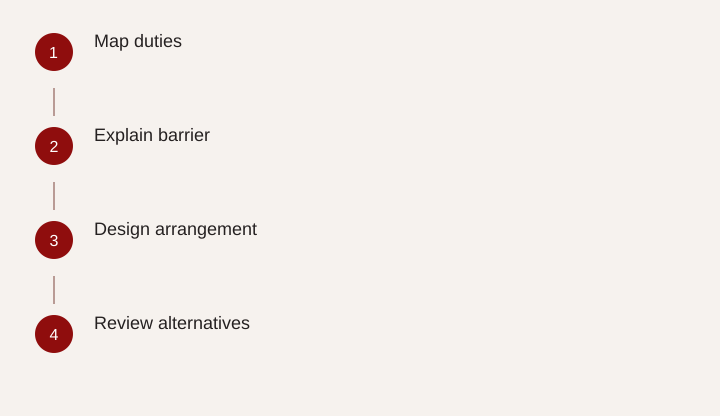
- Map duties
- Explain barrier
- Design arrangement
- Review alternatives
Start with the work, not the location preference
A request to work from home can be difficult to evaluate if it says only that remote work would be better. Begin with the essential duties, the disability-related barrier and how the proposed arrangement would address it. The employer needs to understand both the limitation and the work that must continue.
Separate a general desire for flexibility from an accommodation request. If the issue is a medical condition affecting work under particular circumstances, say so. If you are negotiating an ordinary flexible-work benefit, use that process instead of adding a disability label that does not reflect the facts.
The EEOC accommodation guidance provides the general framework for discussing effective adjustments. It does not make every remote-capable job automatically remote as an accommodation. A task-level proposal gives the discussion something concrete to evaluate.
Map essential duties and where they occur
List the recurring duties, required interactions, equipment, access and service obligations. Identify which tasks appear location-dependent and why. Do not assume that a desk-based title means every duty can be performed away from the workplace.
A hypothetical analyst may spend most of the week reviewing digital records but also participate in scheduled on-site inspections. The proposal should address those inspections rather than omit them. Perhaps the request concerns particular days or another arrangement; perhaps the on-site function requires a different adjustment. The discussion needs accurate facts before those options can be assessed.
Use the employer's current duty description and note any disagreement about actual practice. Ask for clarification if an essential function is described vaguely. Prior arrangements, performance records and team workflows can inform the conversation, but they should not replace a current understanding of the role.
Connect the limitation to the proposed arrangement
Explain the relevant workplace barrier and why remote work would help. Avoid supplying a broad personal history where a functional explanation would be more useful. Supporting professional information may be needed, and it should address the relevant limitation and accommodation need.
For example, if a noisy open workspace creates a barrier, explain the effect on the required tasks and why a quieter setting matters. Then consider whether another effective option exists, such as a different workspace or communication method. If those options would not address the barrier, explain the specific reason.
The JAN negotiation guide encourages employees to offer ideas while considering alternatives. The aim is an effective adjustment, not a contest in which either side must defend the first option proposed. You can be flexible without describing an ineffective arrangement as adequate.
Build a function-and-arrangement matrix
Use the matrix to show how the work would be performed and where questions remain. Include difficult duties rather than only the easiest remote tasks.
| Function | Current requirement | Proposed arrangement | Open question |
|---|---|---|---|
| Individual work | Systems, records and deliverables. | Authorized access and output expectations. | Any security or equipment limitation? |
| Team coordination | Meetings, handoffs and availability. | Communication schedule and escalation route. | Which interactions require presence? |
| Customer or operational service | Coverage and response needs. | How service would continue. | Who handles location-dependent tasks? |
| Occasional on-site duty | Frequency and essential purpose. | Proposed method or separate adjustment. | Can the function still be performed effectively? |
Do not promise to use unapproved systems or have coworkers permanently absorb essential duties without discussion. A proposal should reveal implementation needs, not hide them to make approval appear easier.
Use prior remote work as evidence, carefully
If you performed the job remotely before, identify what that experience demonstrates: completed deliverables, communication methods, access arrangements and any tasks that were postponed or temporarily excused. Include limitations as well as successes.
For federal employees, the current EEOC/OPM telework FAQ emphasizes individualized assessment of present duties and operations. It explains why temporary remote arrangements do not necessarily establish a permanent change to essential functions. It also cautions against blanket decisions that ignore individual circumstances.
That federal guidance should be labeled as federal guidance. A private employee should not assume an agency-specific review procedure applies to their employer. In either setting, avoid arguing from job title alone or from the fact that another employee has a different arrangement whose basis you may not know.
Define a reviewable proposal
Summarize the requested schedule, relevant functions, communication plan and method for assessing effectiveness. Ask which information remains necessary and who will decide. A proposed trial can include a review date and specific work outcomes, but it should not imply that your underlying need expires automatically unless that is actually the situation.
A concise request might say: “I propose [arrangement] to address [barrier]. The attached matrix explains how I would perform the identified duties and the questions that need resolution. I would like to discuss effective alternatives and a review method.”
If the request is denied or modified, ask for the reason and respond to the stated issue. Do not assume submitting a proposal authorizes working remotely before approval. A good proposal makes the decision easier to examine: the limitation, the essential work, the arrangement and the evidence of effectiveness are all visible.
Name the person who would review the trial and the information they would use. Otherwise, a temporary arrangement can end with competing impressions rather than a meaningful evaluation. Record both successful work and unresolved barriers so that a later discussion addresses the actual experience.
Related questions
Does doing the job remotely before prove remote work must continue?
Not necessarily. Prior experience is relevant, but current essential duties, operations and effectiveness still need assessment. Federal guidance expressly calls for an individualized inquiry.
Should I focus on my commute?
Describe the actual disability-related barrier and work circumstances accurately. Do not assume that a general preference to avoid commuting establishes entitlement to remote work.
Sources & further reading
Primary references
- Enforcement Guidance on Reasonable Accommodation and Undue Hardship under the ADA
- Requesting and Negotiating a Reasonable Accommodation
- Frequently Asked Questions from the Federal Sector about Telework Accommodations for Disabilities
Community questions behind this guide
These discussions informed the question and language. Personal accounts are not verified facts or professional advice. Read our method.