
THE SHORT ANSWER
Find the policy's alternate channel, explain the conflict concern and ask who will review the facts. Skepticism about the reporting chain should lead to a clearer route, not an assumption that every route is closed.
What to keep in mind
- Use an alternate channel named in the reporting policy when possible.
- Describe the potential conflict without presenting suspicion as established misconduct.
- Keep external timing questions separate from internal handling.
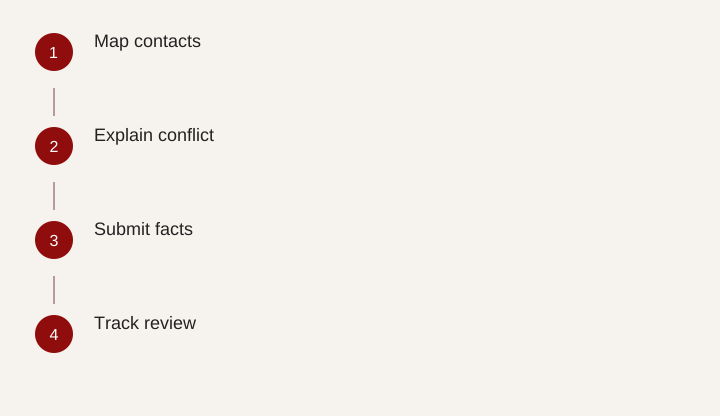
- Map contacts
- Explain conflict
- Submit facts
- Track review
Turn a concern about influence into a routing question
It is difficult to report a manager who appears close to HR, the owner or senior leadership. The concern may be based on observed conduct, the organizational chart or stories about how earlier reports were handled. Begin by separating those sources. Knowing that two people are friends is different from witnessing a report being dismissed without review.
Your first practical question is who can receive and evaluate the concern outside the immediate chain. Read the employer's current reporting policy, including any alternative route when a supervisor is involved. There may be a designated manager, hotline, employee-relations contact or other process. Do not invent an office the organization does not have.
You can ask for process information before distributing the full allegations. “The concern involves my direct manager. Which alternate contact should handle it?” is a reasonable starting point that does not require you to prove a conflict in advance.
Map the channels and their responsibilities
Create a small contact map rather than repeatedly telling the same story to whoever is available. Identify the ordinary reporting contact, the alternative contact and the person responsible for follow-up. Record whether a channel handles discrimination, general conduct, payroll, ethics or another issue.
The EEOC employer guidance discusses effective complaint procedures and reporting options. Use that as a reason to ask how the employer's process works, not as proof that every complaint must go directly to a particular executive.
For federal employment, identify the agency's EEO office separately from ordinary HR administration. The federal EEO overview describes that specialized route. A general management complaint and an EEO matter may overlap, but sending an email to any government manager is not a reliable substitute for identifying the proper process.
Explain the conflict concern precisely
A useful request states why you are asking for alternative handling. “The report concerns my supervisor, who would normally receive complaints under the policy” is straightforward. If the concern goes further, describe the observed event: “The HR contact participated in the meeting I am asking to have reviewed.”
Avoid unsupported statements that everyone is corrupt or that a reviewer will certainly retaliate. Those conclusions may be understandable expressions of fear, but they do not help someone decide how to assign the review. You can state the fear honestly: “I am concerned about impartiality and later treatment because of the following events.”
Ask who will assess the facts, who will receive information and how a concern about the reviewer can be raised. An independent review does not necessarily require an outside investigator. The important point is to obtain an explanation of how the organization will address the specific conflict you have identified.
Use a channel map and request
Fill the map with actual contacts and leave unknowns visible. The blank space is a question to resolve, not an invitation to guess.
| Function | Contact or route | Question |
|---|---|---|
| Initial receipt | Designated alternative | Will this person acknowledge and route the report? |
| Fact review | Assigned reviewer | How will the identified conflict be addressed? |
| Interim work concerns | Named manager or contact | Who can adjust necessary arrangements? |
| Later treatment | Follow-up reporting route | How should new events be reported? |
I need to report [specific concern] involving [role]. Because [factual reason the normal route is implicated], I am requesting alternative handling under the policy. Please identify who can review the concern, how the conflict will be addressed and where I should submit the chronology. I would also like a contact for any immediate work-arrangement or later-treatment concerns.
Make a factual submission and protect the calendar
Once a route is identified, provide a focused account of the strongest events, relevant records and requested review. Ask for acknowledgment and the next process step. Do not rely solely on a verbal assurance that someone important is taking care of it.
Internal handling and external deadlines are separate questions. The EEOC deadline guidance explains that internal grievance efforts generally do not extend the charge-filing period. Federal employees have a different counselor-contact process. If discrimination may be involved, obtain timely information about the applicable route even while asking the employer to resolve the matter.
Avoid forwarding confidential employer records to a personal address as a precaution. Preserve information through authorized means, and identify restricted records for the reviewer. A concern about the reporting chain does not make every method of collecting evidence appropriate.
Plan for continued work and evaluate the response
Reporting may not immediately change who assigns your work. Ask how necessary communication will occur while the matter is reviewed. Keep instructions, deadlines and performance expectations clear. If a proposed interim measure creates a new problem, explain the practical effect and ask about alternatives.
The EEOC retaliation resource identifies protection for relevant discrimination-related activity, but it does not promise that a workplace will become comfortable. Document specific later changes instead of treating every awkward conversation as proof.
Evaluate the process by observable steps: receipt, assignment, information requests, updates and response to continued conduct. If the alternative route also fails to respond, record that history and seek appropriate external or professional guidance. Your objective is a reviewable account and an accountable process, not a contest over who has the strongest personal connection to leadership.
Related questions
Should I email every executive?
A broad distribution can expose sensitive allegations without improving accountability. Start with an appropriate designated alternative and ask for a responsible reviewer, unless the actual policy or circumstances justify another route.
What if HR reports to the person I am complaining about?
Ask what independent or alternative handling is available, such as another designated manager or investigator. The answer depends on the organization; do not assume a particular office exists.
Sources & further reading
Primary references
- Questions and Answers for Small Employers on Employer Liability for Harassment by Supervisors
- Retaliation
- Time Limits for Filing a Charge
- Overview of Federal Sector EEO Complaint Process
Community questions behind this guide
These discussions informed the question and language. Personal accounts are not verified facts or professional advice. Read our method.