
THE SHORT ANSWER
Tell the employer that a medical condition creates a workplace barrier and that you need an adjustment. A clear initial request opens a discussion; it does not require a complete medical history.
What to keep in mind
- Connect the limitation to a task, schedule or workplace barrier.
- Suggest options while remaining open to effective alternatives.
- Ask for the appropriate contact and documentation process.
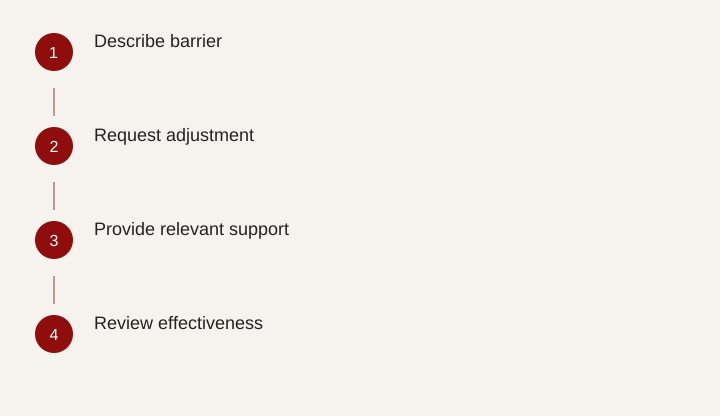
- Describe barrier
- Request adjustment
- Provide relevant support
- Review effectiveness
Explain the barrier and the need for an adjustment
An initial accommodation request should make two things understandable: a medical condition is creating a work-related barrier, and you are asking for a change that may address it. You do not need to begin with an exhaustive diagnosis history or a legal argument.
For example, “Because of a medical condition, I am having difficulty processing spoken instructions in our noisy work area. I would like to discuss an adjustment that allows me to receive the instructions reliably.” This identifies the connection and starts a practical conversation.
The EEOC accommodation guidance explains that requests need not initially be in writing. A written follow-up can nevertheless help document what you asked for and when. This article uses the general ADA communication framework; federal agencies have their own procedures under the Rehabilitation Act, and other applicable rules may provide additional protection.
Describe limitations at the level of the job
Identify the task or condition that is difficult: prolonged standing, a particular schedule, receiving rapid verbal instructions, using inaccessible software or another specific barrier. Explain what you are trying to accomplish at work and where the obstacle occurs.
Avoid describing yourself only through a diagnosis. The same condition can affect different people differently, and a label alone may not explain the adjustment needed. Conversely, do not assume you must disclose every unrelated medical issue to make the request serious.
A hypothetical analyst might say that interruptions make it difficult to complete a required review accurately and ask about a quieter workspace or protected focus period. That is more actionable than saying the entire office is stressful. The employer can then discuss the essential work, available options and any relevant documentation needed to understand the limitation.
Suggest options without treating one as the only possibility
If you have an adjustment in mind, explain how it would help. You can offer more than one option or ask for help identifying possibilities. The Job Accommodation Network guide recommends connecting the request to a medical condition, offering ideas and remaining prepared to discuss alternatives.
Think in terms of effectiveness. Would written instructions solve the communication barrier? Would a schedule change address the limitation? Would equipment, a different method or a revised location help? An option should connect to the work rather than simply being something you would prefer.
The employer may have an alternative you have not considered. You can ask how it would address the barrier and explain any gap. Being open to discussion does not require saying that an ineffective option works. It requires describing the issue clearly enough to evaluate the options.
Adapt this initial request
Use the employer's designated accommodation contact if one is identified. If you begin with a supervisor, ask how the request will be routed. Keep sensitive attachments separate until you know the proper submission method.
Subject: Request to discuss a workplace accommodation
Hello [contact],
I am requesting a workplace adjustment because a medical condition is affecting my ability to [task or activity] under [specific conditions]. The barrier is [brief functional description].
I would like to discuss [proposed adjustment or options], which I believe could help me [perform the relevant work or access the workplace benefit]. I am open to considering other effective options.
Please confirm the person handling the request and the next step. If supporting information is needed, please explain the relevant questions and the appropriate way to submit it. I would appreciate discussing any temporary arrangement that may be available while the request is reviewed.
Thank you, [name].
Delete the temporary-arrangement sentence if it does not fit. Do not describe a requested option as already approved, and do not treat the template as a substitute for any required follow-up.
Provide relevant documentation through the right channel
When disability or need is not obvious, the employer may request reasonable supporting information. The EEOC documentation discussion distinguishes relevant information from unrelated medical records. Ask what is missing and what functional question the documentation should answer.
Give your health professional an accurate description of the job and the barrier. A letter that explains only that you would benefit from less stress may leave the employer uncertain about the requested change. A focused explanation can connect a limitation, the relevant work condition and a possible adjustment without detailing every aspect of treatment.
Ask where the information should be sent and who handles it. Do not distribute medical records to an entire management chain merely to demonstrate urgency. Keep a record of what was requested and submitted so later questions can be addressed precisely.
Follow up and evaluate the result
If you do not receive a response, ask whether the request was received, who owns it and whether information is outstanding. Avoid assuming silence means either approval or denial. If the need is time-sensitive, explain the practical impact and ask what can happen next.
Once an adjustment is implemented, assess whether it works. Record specific examples of improvement or remaining barriers. A trial arrangement is useful only if someone reviews the result and understands the standard for effectiveness.
If the option is denied, ask for the reason and whether another effective arrangement can be considered. Do not let the process end with an unexplained no if the underlying barrier remains. The initial request is the beginning of an informed discussion: clear work facts, relevant support, practical options and a documented next step.
Related questions
Must the first request use a special ADA form?
EEOC guidance says an initial request need not be written or use a special form. An employer may subsequently ask for its paperwork, but the initial communication still matters.
Can I refuse to provide any medical information?
Not necessarily. When disability or accommodation need is not obvious, relevant documentation may be requested. The scope should connect to the disability and need rather than unrelated history.
Sources & further reading
Primary references
- Enforcement Guidance on Reasonable Accommodation and Undue Hardship under the ADA
- Requesting and Negotiating a Reasonable Accommodation
Community questions behind this guide
These discussions informed the question and language. Personal accounts are not verified facts or professional advice. Read our method.
- [MN] HR denied accommodations and is now requesting medical clearance for me to do part of my job without them. And a letter from my doctor to back up any and all new information I provide, is this normal?
- [US] [CT] Made an ADA request to my employer and got denied. Wondering what the next steps are.
- [MA] ADA accommodation denied, do I have any recourse?