
THE SHORT ANSWER
A scholarship should survive basic independent verification. Slow down when an offer guarantees money, demands a fee or asks for information before clearly identifying the sponsor and terms.
What to keep in mind
- Never pay to apply for or receive a scholarship award.
- Find the sponsor independently of an unsolicited message.
- Treat passwords and unexplained sensitive-data requests as separate stop points.
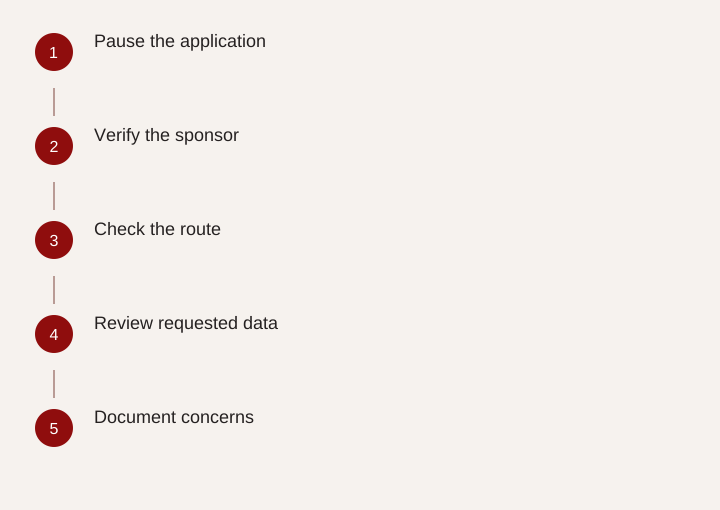
- Pause the application
- Verify the sponsor
- Check the route
- Review requested data
- Document concerns
Slow down before the application collects anything
The moment to verify a scholarship is before paying a fee, creating another account or uploading sensitive documents. An attractive award amount can make a rushed application feel worthwhile, especially when family resources are limited. Treat that urgency as a reason to check carefully, not as evidence that the opportunity is valuable.
The Federal Trade Commission warns about guaranteed awards, fees to obtain scholarships and pressure to act immediately. It also warns against requests for bank or credit-card information to hold an award. These are more meaningful signals than whether a website looks modern.
A scholarship directory may contain legitimate and stale listings at the same time. The word vetted is not enough by itself. Ask what organization actually provides the award and locate that organization's current application information independently.
Verify the sponsor outside the advertisement
Search for the sponsor's official website through a route separate from the message or advertisement. Confirm that the scholarship appears there, with a current cycle, eligibility conditions and contact information. If the application uses an external platform, look for the sponsor's own link to that platform.
Contact the sponsor through the official route when something does not match. A simple inquiry can ask whether the scholarship is currently offered and whether the application address you found is authorized. Do not rely solely on a contact number supplied by a message claiming you have already won.
Be cautious about copying accusations from online forums. A commenter may describe a bad experience, a misunderstanding or an outdated listing. Use the report as a reason to investigate, not as proof that you should publicly call a named organization fraudulent. Your immediate task is to decide whether you can verify the opportunity.
Distinguish a scholarship from a paid service
A sponsor awarding a scholarship is different from a company selling information, application organization or search tools. The FTC notes that legitimate services may sell lists or matching assistance, but they do not guarantee scholarships. Understand the product before deciding whether it is worth paying for.
Never pay to apply for a scholarship or to release an award. A processing fee, redemption fee or payment to confirm selection should stop the application. A promise that the scholarship is guaranteed or your money back is not a reliable safety net; refund conditions can make the promise meaningless.
Also ask whether the information can be obtained free through a school counselor, financial-aid office or the sponsor's website. Convenience may have a price, but it should be described honestly. Do not confuse buying a search service with improving your eligibility or receiving financial aid.
Review each information request
An application may legitimately need information to evaluate eligibility, but the purpose should be clear and connected to an identifiable sponsor. Before providing sensitive details, ask why they are required, how they will be submitted and which official process governs them. Do not assume that every request is appropriate merely because other scholarship applications ask similar questions.
Never share your StudentAid.gov account password with a scholarship consultant or application helper. The FTC specifically warns against giving away the FSA ID credentials used for federal aid. Someone helping you understand a form does not need to take control of your account.
Use the application's official secure route for documents rather than sending them to an unverified personal address. If a request feels excessive at an early stage, ask the sponsor to explain. A refusal to provide basic details or pressure to submit immediately is a reason to stop and seek guidance.
Run a pre-application check
| Check | Evidence you want | Action if missing |
|---|---|---|
| Sponsor | Identifiable organization with an independent official presence | Do not submit yet |
| Award | Current scholarship page and terms | Ask whether the listing is active |
| Route | Official link to the application | Verify the external platform |
| Eligibility | Clear requirements you can read | Request clarification |
| Fees | No payment to apply for or receive the award | Walk away from that demand |
| Data | Explained purpose and appropriate submission method | Ask before sharing |
| Pressure | Time to review and seek advice | Pause rather than rush |
Save the source URL, date and any clarification. The check does not guarantee that no problem can occur, but it turns a vague feeling into a set of verifiable questions. A legitimate-looking design cannot answer those questions for you.
If you have already responded
Stop sending additional information or money while you verify the situation. Preserve the messages, website address, transaction details and documents you submitted. Contact the relevant payment provider promptly if money was sent, using its official support route. Follow official guidance appropriate to the information or payment involved rather than relying on someone promising recovery for another fee.
The FTC's scholarship page links to reporting and recovery guidance and identifies its fraud-reporting channel. You can also tell your school's financial-aid office about a suspicious offer, particularly if it claims a relationship with the institution. Describe the evidence accurately and distinguish what happened from what you suspect.
For future applications, keep the verification checklist beside your shortlist. Checking a sponsor once is more efficient than repeatedly wondering whether an attractive listing is safe. The aim is to preserve your time, information and money for opportunities whose source and terms can be established.
Related questions
Does a .org domain prove a scholarship is legitimate?
No. Verify the sponsor and application through independent official information rather than relying on the address ending.
Are all scholarship search services scams?
No. The FTC distinguishes information services from fraudulent promises. A paid search service still does not guarantee an award.
Sources & further reading
Primary references
Community questions behind this guide
These discussions informed the question and language. Personal accounts are not verified facts or professional advice. Read our method.