
THE SHORT ANSWER
A useful log helps another person reconstruct events. Record specific facts promptly, preserve uncertainty and keep complaint deadlines separate from the documentation project.
What to keep in mind
- Label firsthand facts, reported information and interpretation separately.
- Identify records without copying material you are not authorized to retain.
- Use the log to support a concise report, not replace timely contact.
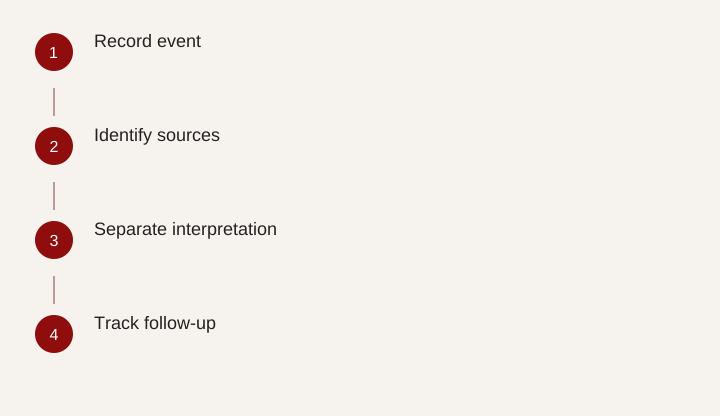
- Record event
- Identify sources
- Separate interpretation
- Track follow-up
Write so someone else can reconstruct the event
A workplace incident log is a memory aid and an organizational tool. It should tell another person what happened, when, who was involved and how you know. It is not a place to turn every suspicion into a fact or rehearse an argument about the other person's character.
Write promptly, while details are fresh. If you make a later entry about an earlier event, include both dates. “Written on Friday about Tuesday's meeting” is more transparent than presenting the note as contemporaneous. If the time is approximate, say so.
Use ordinary language. A sentence such as “The manager interrupted my answer three times and said I was not suited for customer work because of my accent” communicates more than a page labeled hostile environment. The legal or policy significance can be assessed later; the underlying words and actions are what your record needs to preserve.
Use fields that separate different kinds of information
A consistent format makes a pattern easier to see without forcing every event into the same conclusion. Keep the factual description separate from your concern about its meaning.
| Field | What to record |
|---|---|
| Event date and entry date | Exact or approximate timing, clearly labeled. |
| Setting and participants | Meeting, message, location and relevant people. |
| Observed conduct | Actions and words you personally observed. |
| Other information | Who told you what; do not present it as firsthand knowledge. |
| Work effect | Change in duties, access, schedule, performance or participation. |
| Evidence location | Authorized records or witnesses that may clarify the event. |
| Response and follow-up | What you did, whom you contacted and what happened next. |
| Interpretation or question | Your concern and what remains uncertain. |
You do not need a specialized app. A document or spreadsheet can work if it is stored appropriately. Choose a format you can maintain accurately rather than one with so many fields that you stop using it.
Preserve quotations and uncertainty honestly
Use quotation marks only when you can reasonably recall the exact wording or have an authorized written source. Otherwise write a summary and label it as such. A precise-looking invented quotation can undermine an otherwise sound account.
For a hypothetical entry: “Approximately 10 a.m., project meeting. The supervisor said, in substance, that clients would respond better to someone with a local accent. I do not recall the exact sentence. The assignment was given to another employee later that afternoon.” This separates remembered meaning from exact words and distinguishes the comment from the subsequent action.
Include facts that do not fit your initial interpretation. If the employer gives a reason, record it. If you later learn the assignment was changed before the meeting, add that information. A log that can accommodate correction is more useful than one designed only to confirm a conclusion.
Identify evidence without creating a new problem
Relevant evidence may include emails, schedules, evaluations, meeting invitations, messages or witnesses. Record the date, subject and location of material you are not allowed to copy. Ask the appropriate reviewer how to preserve it through authorized channels.
Do not move government, customer, medical, privileged, proprietary or otherwise restricted records to a personal device simply because you believe they support your concern. Do not access someone else's account or personnel file. Likewise, recording conversations can raise legal and policy issues; a written note is a different activity from secretly making an audio recording.
For witnesses, record who was present and what they may have observed. Avoid drafting their account for them or organizing a shared version of events. A reviewer needs independent recollections. You can say that a colleague attended the meeting without claiming that the colleague agrees with your interpretation.
Turn the log into a usable report
When you are ready to raise the concern, lead with a short summary and the clearest events. A large log should support the report rather than become the entire message. Group related issues and explain why they matter to the requested review.
The EEOC harassment overview emphasizes context and the overall record. That does not mean every ordinary workplace frustration belongs in the file. Include recurring conduct, consequential decisions and relevant responses; omit unrelated complaints that distract from the concern.
A useful attachment index might list “A: assignment change dated May 4; B: meeting note dated May 5; C: follow-up email dated May 6.” Keep originals separate from your analysis. If you correct an entry, preserve the original wording or mark the correction so the history remains understandable.
Document while also watching the calendar
Do not wait for a perfect file before seeking information about a deadline. The EEOC charge-deadline guidance explains that time limits may apply separately to events and generally are not extended by internal grievance processes. Federal employees should consult the agency EEO process, which has a different starting step.
Maintain a separate process tracker: date reported, recipient, acknowledgment, next promised action and notice received. This prevents the incident chronology from swallowing important administrative steps. A report about new conduct may also require a new timing question.
Finally, use the log as a tool rather than a constant monitoring exercise. Make a clear entry, complete the necessary follow-up and return to your work or support plan. Its purpose is to preserve reliable information, not to require you to relive every interaction throughout the day.
Related questions
Should I document every unpleasant interaction?
Focus on incidents relevant to the concern, repeated patterns and significant changes. A selective factual record is usually more useful than pages of ordinary disagreements.
Can I forward work emails to my personal account as evidence?
Do not assume that is permitted. Follow applicable confidentiality, security and records rules. You can identify a document's date, subject and location for an authorized reviewer instead.
Sources & further reading
Primary references
Community questions behind this guide
These discussions informed the question and language. Personal accounts are not verified facts or professional advice. Read our method.