
THE SHORT ANSWER
A strong complaint email identifies the conduct, explains why you are raising it and asks for a process. It does not require legal jargon or a predetermined disciplinary demand.
What to keep in mind
- Lead with a clear concern and the strongest specific incidents.
- Separate firsthand facts from information supplied by others.
- Request acknowledgment, a responsible contact and a way to report further events.
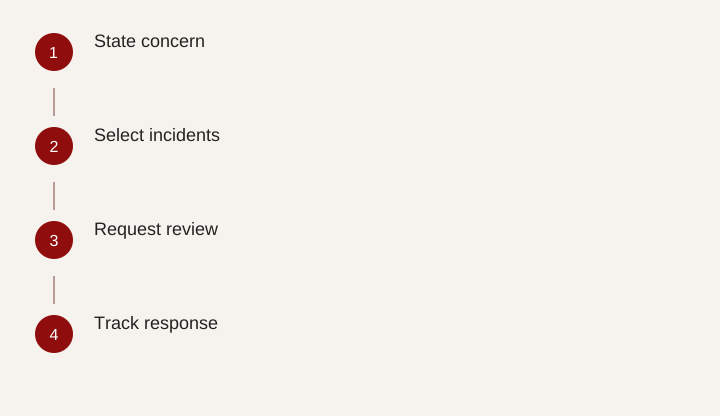
- State concern
- Select incidents
- Request review
- Track response
Make the purpose clear in the first paragraph
An HR complaint should tell the recipient what you want reviewed. “I am writing to report repeated comments about my national origin” is clearer than beginning with a long history of every difficulty on the team. If you are uncertain about the label, describe the conduct and the concern it raises.
Include your role, department and the people involved when that information is not obvious. Identify whether the matter is ongoing and whether there is an immediate work arrangement you need addressed. Avoid a dramatic subject line or an email sent to a broad list of executives. Use the reporting channel identified in the employer's policy.
The purpose is not to make the message sound like it was written by a lawyer. It is to make the issue understandable to someone who was not present. Specific language helps the recipient determine who should handle the matter and what information to request next.
Choose the strongest incidents
Use a few dated examples in the main message and attach a longer chronology if necessary. For each event, include the setting, conduct, people present and work effect. State whether the wording is exact or a summary. Do not describe a witness as supporting your interpretation unless that person has actually said so.
For a hypothetical example, write: “During the June 4 supplier visit, a coworker introduced me as eye candy while I was responsible for the audit. The supplier manager and two colleagues were present.” That explains both the remark and the professional context. It is more actionable than saying the coworker constantly disrespects women.
The EEOC harassment overview discusses the importance of context. Your report should supply that context without trying to decide the entire legal question. Include previous requests that the behavior stop and the response, if any.
Explain the concern and the change you need
Connect the incidents to the issue you want reviewed. If you are concerned about national origin, sex, disability or another protected basis, explain the words or treatment that raised that concern. If the issue is a general conduct or workload problem, describe it accurately rather than adding a discrimination label to make the email sound more serious.
Then identify a practical request. You might need the conduct to stop, a decision reviewed, a different reporting contact or a temporary arrangement while the matter is investigated. Ask for appropriate measures rather than assuming one particular remedy is guaranteed.
You can also ask how to report further incidents. The EEOC retaliation resource explains protections associated with discrimination-related activity. A clear report is useful, but no wording can guarantee that the workplace will respond well. Keep legitimate work expectations and the complaint process visible as separate matters.
Adapt this email to the facts
Use only statements that are true for your situation. Delete optional details rather than filling them with assumptions. If the employer requires a form, the same structure can help you complete it.
Subject: Request for review of workplace conduct
Hello [designated contact],
I am requesting a review of [specific concern] involving [person or role]. I work as [role] in [department]. The concern is [ongoing or limited to identified events].
On [date], during [setting], [specific words or actions]. [People or roles] were present. The effect on my work was [concrete effect, if any]. On [second date], [second relevant incident]. I have identified supporting records in the attached chronology.
I am concerned that [explain the relevant connection or policy issue]. I previously raised this with [person] on [date], and [accurate response].
I am requesting [review and practical change]. Please confirm receipt, identify who will handle the matter and explain the next step. Please also let me know how information will be shared and how I should report additional incidents or concerns about later treatment.
Thank you, [name and contact information].
If the first incident is especially serious or there is an immediate safety concern, do not bury it beneath background details. Use the appropriate urgent channel in addition to a written record.
Organize attachments and confidentiality questions
Attach a concise chronology and only relevant records you are authorized to share through that channel. Give each attachment a descriptive name and explain what it shows. A large collection of screenshots without dates or context makes review harder.
Separate medical information or other sensitive material from a general conduct complaint unless it is necessary for the issue and the recipient is authorized to receive it. Ask for the correct submission method where appropriate. Do not copy coworkers merely to create pressure or demonstrate support.
The EEOC employer guidance discusses protecting confidentiality to the extent possible. Ask what that means in the actual process. An investigation may require discussing allegations with the subject and witnesses, and a small team may make your identity apparent even without a broad disclosure.
Follow up on the process, not only the outcome
Save the submitted version through an authorized method and record the date and recipient. If you receive no acknowledgment, follow up with a short reference to the original message and ask who is responsible. Avoid rewriting the entire complaint each time unless new facts need to be added.
At a meeting, ask what information is missing and when you can expect a process update. You may not receive another employee's disciplinary details. You can still ask whether the review is complete, what work arrangements apply and whom to contact if the conduct continues.
Correct factual errors promptly and label new incidents as additions. Do not assume that an internal report automatically protects every external right or deadline. The email is the start of a documented process, not proof that the issue has been resolved. A clear next action and responsible contact are more useful than an undefined promise that HR will look into it.
Related questions
Do I need to use the words discrimination or harassment?
Use accurate language that makes your concern understandable. If you believe a protected characteristic is involved, say what connection you are concerned about rather than relying on a vague complaint about unfairness.
Should I demand that the person be fired?
You can explain the protection or change you need, but a useful report leaves the employer room to investigate and decide appropriate action. A punishment demand is not a substitute for describing the conduct.
Sources & further reading
Primary references
- Harassment
- Retaliation
- Questions and Answers for Small Employers on Employer Liability for Harassment by Supervisors
Community questions behind this guide
These discussions informed the question and language. Personal accounts are not verified facts or professional advice. Read our method.