
THE SHORT ANSWER
Start at the official FAFSA process for the academic year you need. Identify required contributors, prepare records securely and verify completion before assuming the application has been processed.
What to keep in mind
- Use the correct award year and current official instructions.
- Each required contributor uses their own account.
- Submitting your section may not complete every required step.
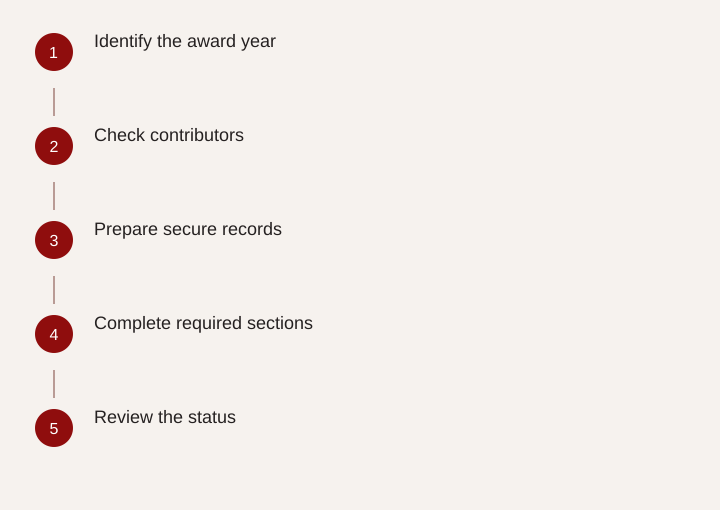
- Identify the award year
- Check contributors
- Prepare secure records
- Complete required sections
- Review the status
Start with the academic year and official deadlines
The first question is which academic year the aid application covers. Do not select a form merely because it is the newest one you see or use a saved checklist from a previous cycle without checking it. The relevant tax and financial instructions can depend on the form and award year.
Use the official FAFSA route linked from Federal Student Aid's checklist. Check the deadlines for the school and state as well as the federal process. A broad national deadline does not tell you when every institution considers applicants for all available aid.
Make a small deadline record with the year, school, source URL and action required. If two dates seem inconsistent, ask the financial-aid office what each one means. Do not rely on a social-media date without identifying the program and year it describes.
Identify contributors using the actual process
A contributor is someone required to provide information as part of the form. Depending on the student's circumstances, that may include a parent or spouse. Use the official questions and guidance to determine who must participate instead of assuming that the person who pays most expenses or lives closest is always the required contributor.
The FSA checklist links to official parent-identification help. This is especially useful when family arrangements are not straightforward. Describe your circumstances accurately and ask the financial-aid office where the official instructions leave uncertainty. Avoid replacing a formal contributor rule with an informal idea of who feels like the main parent.
Explain an important point at the family meeting: FSA states that participating as a contributor does not itself make that person responsible for education costs. That can address a common concern, while leaving any separate borrowing decision to its own process and terms.
Prepare separate accounts and protect access
The student and each required contributor use their own StudentAid.gov account. The account functions as a digital signature, so it should not be shared as a convenient family login. A parent can help the student understand instructions without taking over the student's identity or credentials.
Choose a time when each person can access their own email and complete the steps required of them. Record only a safe status note such as account created or invitation pending. Do not place passwords, full identification numbers or tax records in a shared planning spreadsheet that other people can access casually.
The FTC's scholarship and aid guidance warns against sharing FSA ID credentials with consultants. Paying someone does not authorize them to control the account or invent information. The FAFSA form itself is free to complete and submit.
Gather the records the current form requests
Use the current official checklist to identify the records needed for your circumstances. These may include tax information, relevant financial records and a list of schools. Follow the form's instructions about the applicable years and categories; do not guess from a general article or reuse numbers simply because they are easy to find.
FSA's checklist explains that required participants must provide consent and approval for the transfer of federal tax information, including circumstances where a tax return was not filed. Read the current instructions carefully and use the official help process if the consent or financial questions are unclear.
If your family's financial situation has changed, do not alter historical information to make the form resemble today's circumstances. Complete it as instructed, then ask the school about its process for reviewing changed circumstances. Keep the two steps distinct so an understandable concern does not lead to an inaccurate application.
Use a family preparation agenda
| Agenda item | Decision or status to record |
|---|---|
| Award year | The academic period the form covers |
| Deadlines | Verified school, state and federal dates relevant to you |
| Contributors | Who must participate according to official guidance |
| Accounts | Whether each person has their own working account |
| Records | Which current instructions identify needed documents |
| School list | Schools to include and any state-specific guidance to check |
| Completion | Who has finished required sections and signatures |
| Follow-up | Status check and questions for the financial-aid office |
Keep the meeting focused on preparation rather than resolving every future college expense. Assign the next action to the person who must complete it. A student can remind a parent about an invitation, but the parent should complete their own required account steps.
Check the status before assuming you are done
After submitting, review the official status and any messages about missing sections, signatures or corrections. A student finishing their own portion does not necessarily mean every contributor has completed the required work. Follow the current form's instructions rather than treating an email receipt as a final aid decision.
When the form is processed, review the information available to you and address errors through the official correction process. Keep copies or records in a secure location appropriate for sensitive information. Contact the school about next steps, verification requests or documents it needs through its own established channels.
Finally, distinguish an application result or estimate from a school's aid offer. Completing FAFSA is a step in the aid process, not a guarantee of a particular grant or an obligation to accept every loan later offered. Your family's first experience becomes more manageable when each stage has a clear owner, a verified instruction and a visible completion status.
Related questions
Does being a contributor make my parent responsible for paying tuition?
Federal Student Aid states that participating as a contributor does not itself make the family member responsible for education costs.
Should my family share one StudentAid.gov account?
No. Students and required contributors use their own accounts and should not share account credentials.
Sources & further reading
Primary references
Community questions behind this guide
These discussions informed the question and language. Personal accounts are not verified facts or professional advice. Read our method.