
THE SHORT ANSWER
A higher starting step is discretionary and must be approved before entry on duty under the applicable authority. Build a relevant qualifications case and ask HR which rules apply to your appointment.
What to keep in mind
- A higher starting step changes pay within a grade; it does not automatically change the grade.
- OPM prohibits using nonfederal salary history or competing-offer salary under this authority.
- Seek a decision before entry on duty and do not assume approval.
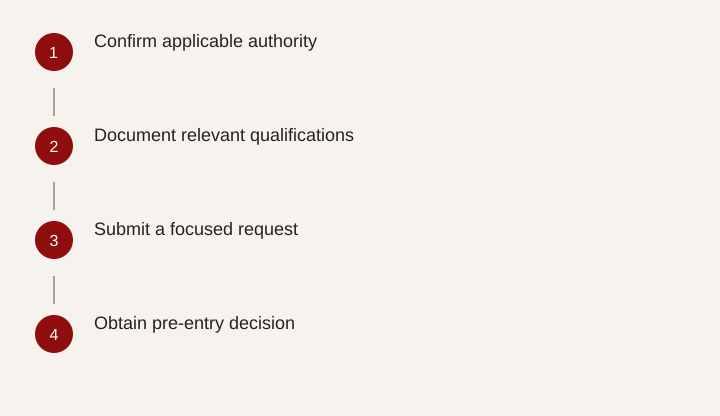
- Confirm applicable authority
- Document relevant qualifications
- Submit a focused request
- Obtain pre-entry decision
Separate the offered grade from the starting step
A federal salary discussion begins with the pay system and offered grade, not the top number in an announcement's range. In the General Schedule, a step is a pay level within a grade. OPM's GS overview explains that new GS employees are usually hired at step 1, while certain authorities can allow a higher starting rate.
Asking for a higher starting step is therefore different from asking to be appointed at a higher grade. The latter depends on the vacancy, qualifications and selection circumstances. Confirm the grade and applicable pay schedule with HR before preparing a request. A locality adjustment or special rate can also affect the displayed salary. Use the actual offered terms as your baseline rather than comparing an annual figure from another location or a different pay system.
Ask whether the authority applies to your appointment
OPM's superior-qualifications and special-needs pay-setting authority allows agencies, at their discretion, to set certain newly appointed GS employees above step 1. The authority has eligibility conditions and agency procedures. It is not an automatic entitlement for everyone with substantial experience, and not every federal pay situation uses this rule.
Ask the HR contact which pay-setting authority applies and whether the agency will consider a request. Current or former federal employees may have different circumstances requiring a separate analysis. Provide accurate employment history rather than assuming that any move into a new agency counts as a qualifying new appointment. The agency decides whether the legal conditions and its own approval requirements are satisfied. Clarifying that point first prevents you from assembling a persuasive but irrelevant packet under the wrong rule.
Build evidence that relates to the position
The request should explain why your qualifications or the agency's needs justify consideration beyond the ordinary starting rate. Focus on relevant skills, education, accomplishments or experience and how they support the work the agency needs done. Merely meeting the minimum qualification requirement does not, by itself, establish the case you are trying to make.
A hypothetical analyst might identify substantial experience with the exact program data, a relevant specialized credential and responsibility for resolving difficult issues similar to those in the vacancy. The useful evidence describes scope and results that can be substantiated. It does not claim that age, personal expenses or a previous title automatically requires a particular step. Avoid sending a long autobiography. A concise explanation with a small number of strong, position-specific examples is easier for HR and the approving official to evaluate.
Use a qualifications request outline
Adapt this outline to the process HR identifies. It is a drafting aid, not a promise that the agency will accept or approve the request.
| Part | What to include | What to avoid |
|---|---|---|
| Request | Position, offered grade and request for consideration | Assuming a higher step is owed |
| Applicable process | Authority or instructions confirmed by HR | Using another agency's practice as a rule |
| Relevant qualifications | Two or three documented examples | Unsupported claims of unique expertise |
| Agency connection | How those capabilities fit the position | Personal budget needs as the qualifications case |
| Supporting material | Only requested or relevant documentation | Unnecessary sensitive records |
| Timing | Request for a decision before entry on duty | Assuming it can be fixed after starting |
For each example, state your personal contribution and the relevant context. If you use a result or number, make sure it is accurate and understandable without confidential employer information. The reviewer should be able to see the connection between the evidence and the offered duties.
Do not build the request on salary history
Older discussions often recommend sending pay stubs or a competing offer to obtain a salary match. That advice conflicts with the current OPM rule for this authority: agencies may not use an applicant's nonfederal salary history or the salary in a competing offer to set pay under it. Do not present those figures as the basis for your superior-qualifications request.
You can still decide privately whether the offered compensation meets your needs. That personal decision is different from the agency's permitted pay-setting rationale. If HR requests information and you are unsure how it relates to the applicable authority, ask for clarification rather than assuming an old forum template controls. Keep the written request focused on the factors the agency can consider. An understandable desire to avoid a pay cut does not change the rule's evidentiary requirements.
Get the timing and decision in writing
OPM requires approval under this authority before the employee enters on duty; approval cannot be made retroactively. Raise the issue promptly, often when discussing a tentative offer, and ask HR how the request affects proposed start arrangements. Do not wait until the first paycheck to discover that the agency never approved a higher rate.
A short closing request can say: “Please let me know whether the agency will consider this material under the applicable authority and what additional information is required before entry on duty.” Confirm the final pay terms in the offer and reporting correspondence. If the request is denied, evaluate the confirmed offer using your own budget and priorities. Do not treat a pending request as approved income. The practical outcome is a clear, lawful request and an informed acceptance decision, whether the agency grants a higher step or retains the original offer.
Related questions
Can an agency use my private-sector salary to set a higher starting step under this authority?
No. OPM's superior-qualifications and special-needs authority prohibits using nonfederal salary history or salary from a competing offer for this purpose.
Can the agency approve this higher step after I start?
OPM requires approval before entry on duty under this authority and does not permit retroactive approval. Raise the question promptly with HR.
Sources & further reading
Primary references
Community questions behind this guide
These discussions informed the question and language. Personal accounts are not verified facts or professional advice. Read our method.